Build enterprise AI work surfaces without giving up control.
HeadGym gives enterprises a decoupled AI architecture for building secure, custom work surfaces on top of an engine that runs where the business needs it — on your desktop, in your cloud, on-premise, hybrid, or fully air-gapped.
Build and distribute AI applications without deploying new servers.
Run the engine inside your network boundary while adapting apps, tools, and access models for teams, departments, and regulated environments.
01 — Core model
The three-layer architecture built for enterprise control
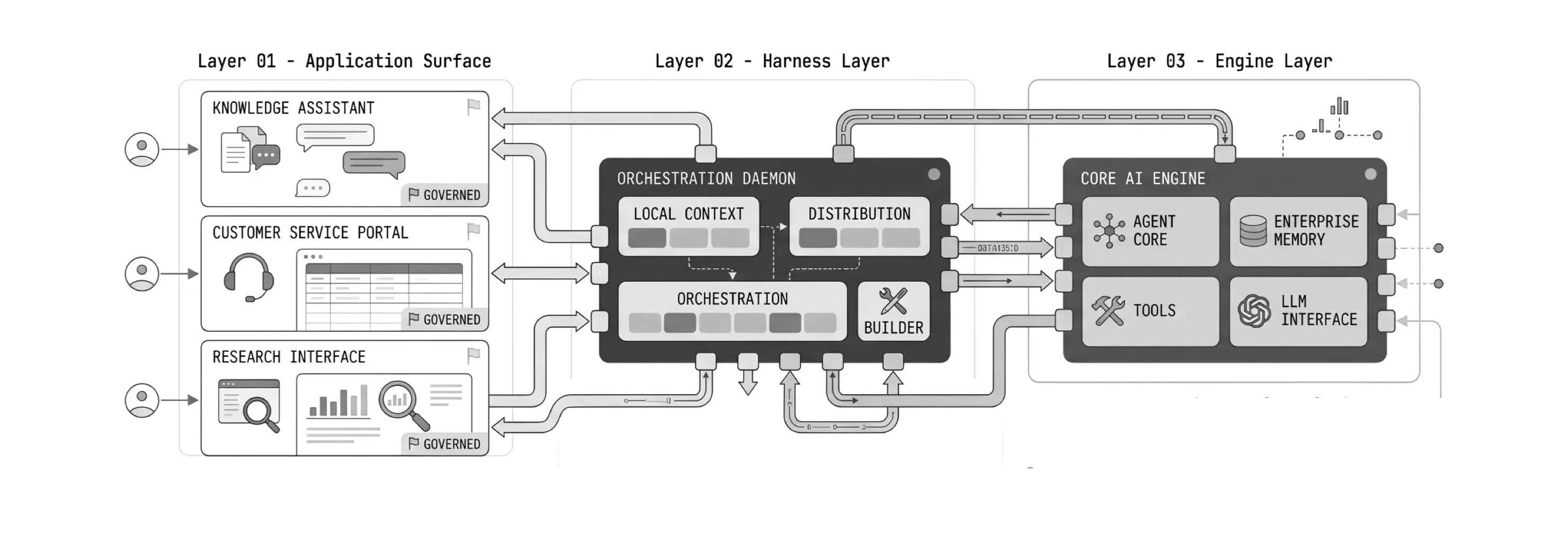
HeadGym is built around a clear architectural separation that makes enterprise AI easier to own, secure, and evolve.
Desktop Workspace
Teams interact with AI through custom-built interfaces tailored to their specific tasks and workflows, all built and deployed within the workspace. HeadGym enables creating applications like knowledge assistants or service portals while preserving the core engine's integrity.
Desktop Harness
The harness handles local context, distribution, and orchestration. It connects the application surface to the engine and makes it possible to build and customise applications efficiently, including at the level of individual users or teams.
Runtime Engines
The engine contains the agent core, memory, tools, and LLM interface. It runs inside the enterprise’s chosen environment and becomes the governed centre of AI capability across the organisation. HeadGym provides runtime admin consoles for management.
02 — The problem
Why enterprise AI adoption breaks down in practice
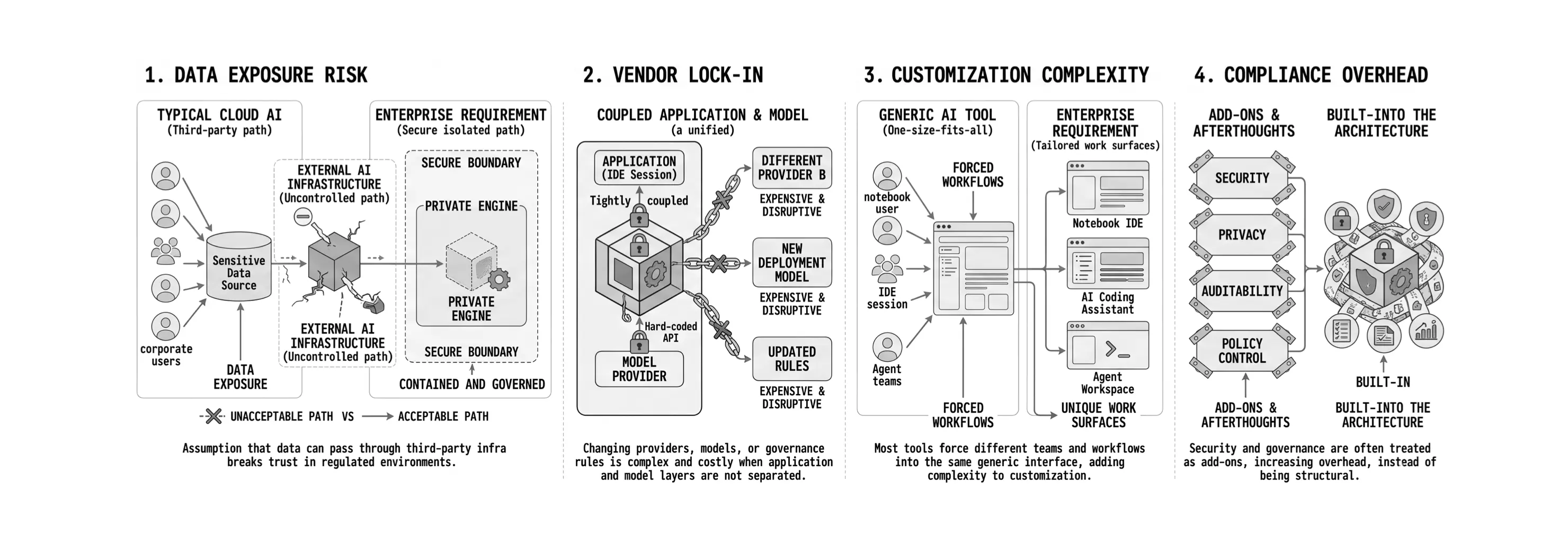
Most enterprises do not struggle to find AI demos. They struggle to deploy AI in a way that fits how their organisation actually operates. The blockers are rarely about model capability alone. They are about architecture: where the system runs, how it connects to internal data, how far it can be customised, and whether the business remains in control as usage grows.
Many AI products assume sensitive data can pass through third-party infrastructure, which is unacceptable for regulated, high-trust, or mission-critical environments.
When the application and model layer are tightly coupled, changing providers, deployment models, or governance rules becomes expensive and disruptive.
Enterprises need different work surfaces for different teams, but most AI tools force everyone into the same generic interface and workflow.
Security, privacy, auditability, and policy control are often treated as add-ons instead of being built into the architecture from the start.
03 — Lifecycle
Deploy, adapt, govern — as one enterprise operating loop
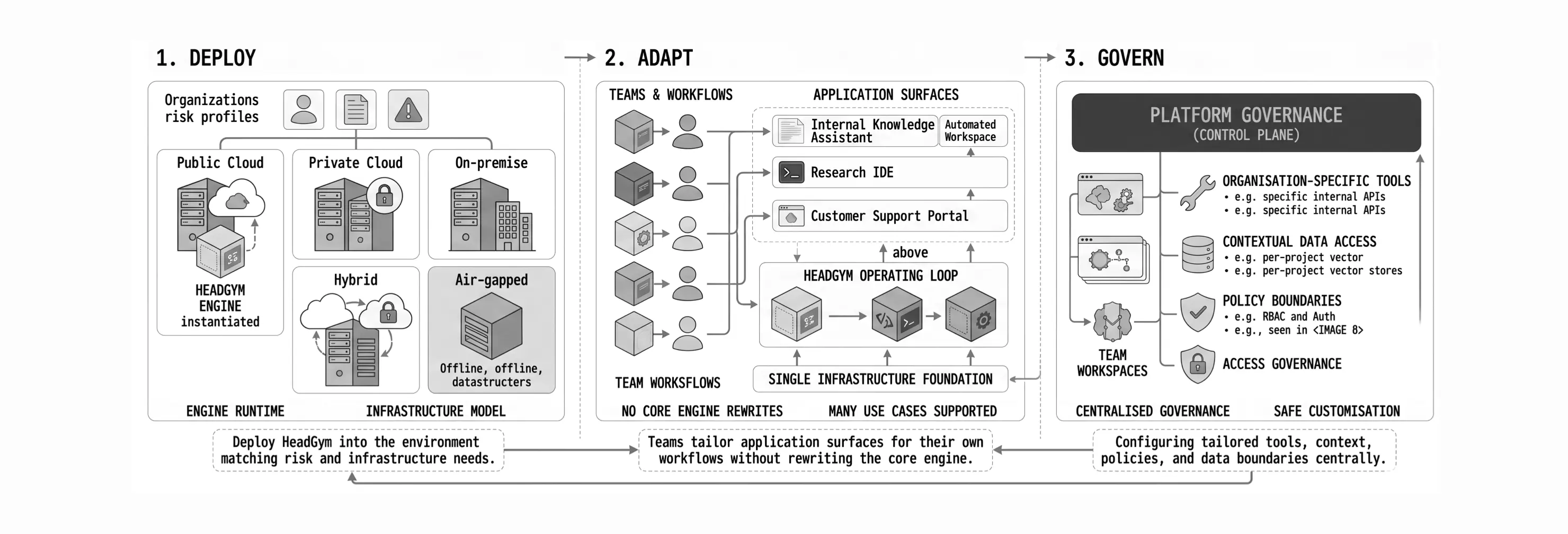
HeadGym is not only a runtime engine and not only a user interface. It creates a complete operating loop for enterprise AI: deploy the core engine where it belongs, connect applications through the harness, and govern how teams use AI over time.
Deploy
Organizations deploy the HeadGym engine into the environment that matches their risk profile and infrastructure model — public cloud, private cloud, on-premise, hybrid, or air-gapped.
Adapt
Teams build or tailor application surfaces for their own workflows without rewriting the core engine. That means one infrastructure foundation can support many different enterprise use cases.
Govern
The engine can be configured with organisation-specific tools, context, policies, and data access boundaries, so governance stays centralised even while experiences are customised.
04 — Platform Architecture
Build custom AI applications above the engine layer
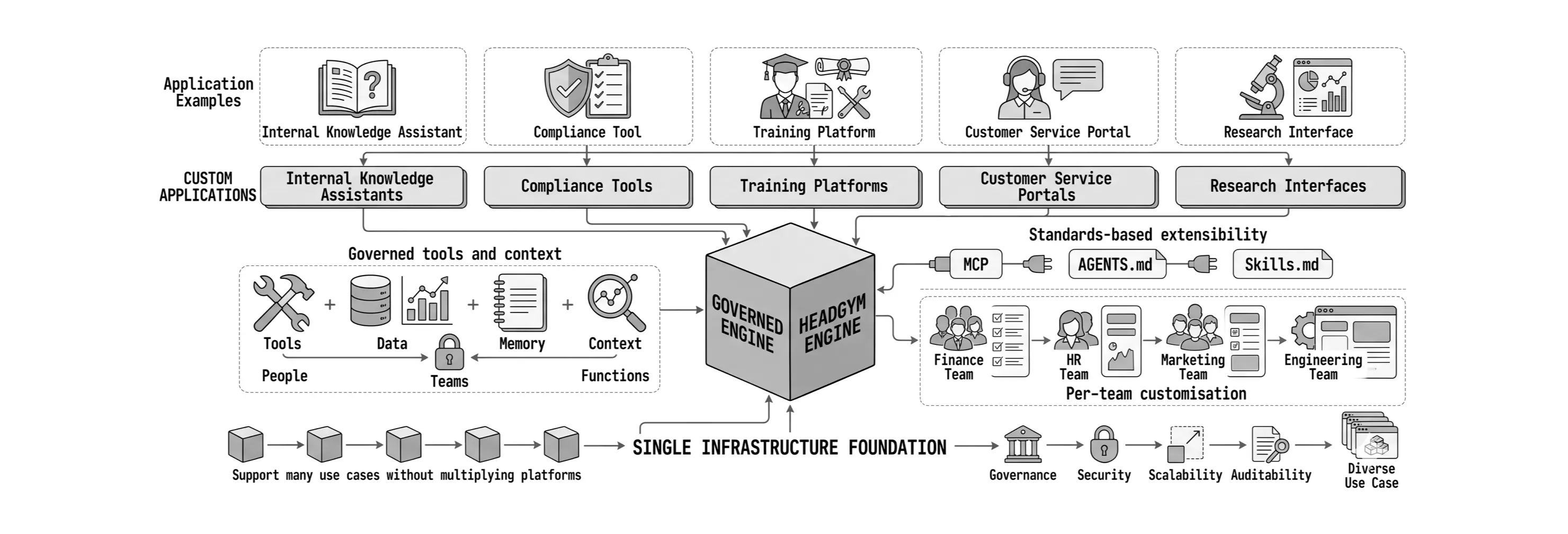
Instead of forcing enterprises into a single assistant experience, HeadGym provides an architectural base for many AI-powered work surfaces. Teams can build specialised applications while keeping the core intelligence, tools, and governance in the engine.
Build internal knowledge assistants, compliance tools, training platforms, customer service portals, and research interfaces on top of the same HeadGym engine without rewriting the core engine.
Each engine can define a unique mix of tools, data sources, memory, and context, with access controlled centrally and tailored safely for people, teams, or functions.
HeadGym is designed to work with established plugin and orchestration standards such as MCP, AGENTS.md, and Skills.md, making integrations more portable and future-ready.
Applications can be adapted cost-effectively for specific departments or individual users without creating a fragmented AI estate.
Different experiences can sit on top of the same governed engine, allowing enterprises to support many use cases without multiplying platforms.
Designed for a future where AI systems are built, extended, and guided by AI
Because HeadGym exposes clear architectural layers and well-defined interfaces, it is well suited to AI-assisted development. Teams can use AI tools to help build, customise, and maintain work surfaces more reliably when the underlying platform is explicit rather than improvised.
Clear structure for AI tooling
A decoupled architecture gives AI coding agents a more understandable system to work with, reducing ambiguity between application logic, orchestration, and engine capability.
Standards that support machine guidance
Support for conventions and standards such as AGENTS.md, Skills.md, and MCP-style tooling makes it easier to embed project guidance and reusable patterns into the development workflow.
Faster application iteration
Teams can move more quickly from concept to prototype to production work surface because the engine, harness, and application responsibilities are already separated.
Safer enterprise customisation
AI can help generate and adapt application-layer experiences while the governed engine remains the stable source of security, tooling, and policy control.
DevOps burden drops when AI infrastructure is structured correctly
HeadGym is designed so enterprises can own their AI infrastructure without inheriting unnecessary operational sprawl. The architecture reduces coupling, clarifies responsibilities, and makes deployment choices part of the product model rather than a one-off engineering exercise.
Run the engine in your cloud account, private network, data centre, or isolated environment depending on operational, regulatory, and security requirements.
Organisations can choose an engine licence for full internal control, a managed engine for reduced operational burden, or an enterprise platform model for broader enablement and custom delivery.
By reusing the same core engine across multiple work surfaces, platform teams avoid rebuilding AI operations separately for each business use case.
Security and compliance become part of how the system is deployed and governed, rather than depending entirely on process overlays and vendor assurances.
High scale and integration readiness
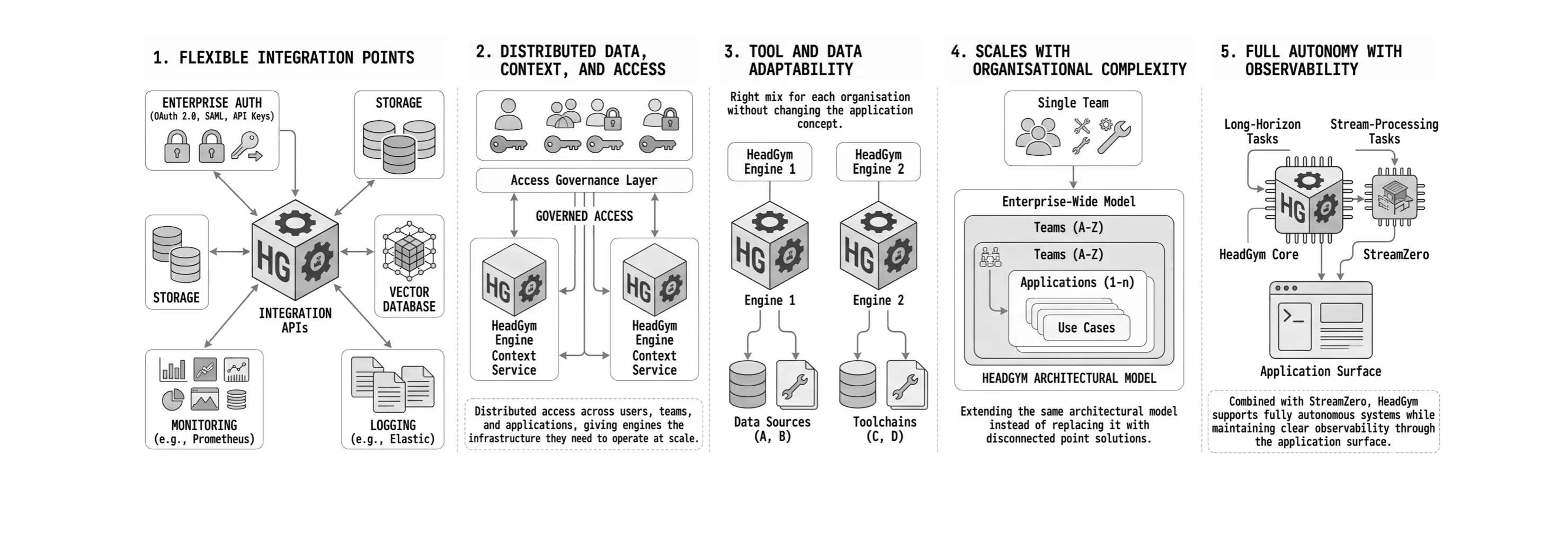
Enterprise AI infrastructure must connect and scale, not just answer prompts. HeadGym is designed as an infrastructure layer, which means it must fit into enterprise systems and support serious operational demands.
Flexible integration points
Support includes standard enterprise authentication patterns such as OAuth 2.0, SAML, and API keys, along with storage, vector database, monitoring, and logging integrations.
Distributed data, context, and access
HeadGym supports distributed access to knowledge, context, and memory, giving engines the infrastructure they need to operate at scale with governed access across users, teams, and applications.
Tool and data adaptability
The engine can be configured with the right mix of data sources, toolchains, and context for each organisation without changing the application concept.
Scales with organisational complexity
As more teams, applications, and use cases come online, enterprises can keep extending the same architectural model instead of replacing it with disconnected point solutions.
Full autonomy with observability
Combined with StreamZero, HeadGym can support fully autonomous systems for long-horizon and stream-processing tasks while maintaining clear observability through the application surface.
Built for the infrastructure layer
The strategic value of HeadGym is that it helps enterprises move beyond renting a generic AI interface and toward owning the way AI is deployed, governed, and operationalised.
Understand how enterprise AI is configured, used, and trusted
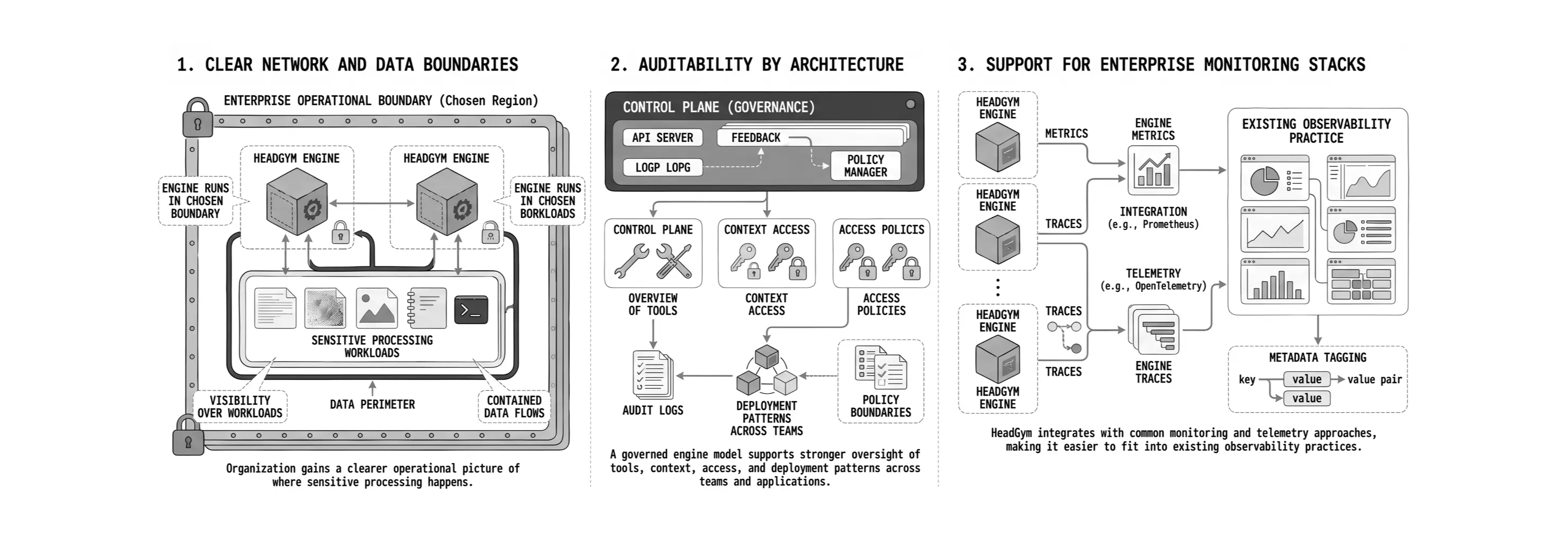
In enterprise settings, observability is not just about uptime. It is about proving where AI runs, what it can access, how it is configured, and how it supports accountable outcomes.
Clear network and data boundaries
Because the engine runs within the enterprise's chosen boundary, organizations gain a clearer operational picture of where sensitive processing happens.
Auditability by architecture
A governed engine model supports stronger oversight of tools, context, access, and deployment patterns across teams and applications.
Support for enterprise monitoring stacks
HeadGym integrates with common monitoring and telemetry approaches such as Prometheus metrics and OpenTelemetry traces, making it easier to fit into existing observability practices.
Confidence for regulated environments
The architecture helps organizations in banking, healthcare, defense, legal, and other sensitive sectors build trust on top of technical controls rather than marketing claims.
08 — Why it matters
A cleaner path from AI experimentation to owned enterprise capability
HeadGym helps organisations move from fragmented AI pilots to a durable infrastructure strategy.
For business teams
A faster path to building specialised AI work surfaces for real departments, workflows, and customer needs.
For architects & leaders
A modular architecture that lets systems evolve without full rebuilds and positions AI as owned infrastructure, not rented interfaces.
For platform & security teams
Stronger control over deployment boundaries, model choice, data access, and governance in environments where compliance matters.
HeadGym is AI infrastructure you can actually own
Deploy the engine where your organisation needs control. Build application surfaces that fit real teams. Govern tools, models, and data centrally. Evolve your AI stack without locking your business into a single interface or provider.
If you are evaluating how to deploy enterprise AI without compromising sovereignty, flexibility, or customisation, HeadGym is the architecture to assess first.